
Collated from our Newsletters into one Section. To provide an easier access to what matters most: NATURE!
Marine Biology Maldives | 2025 December: Do Stingrays actually sting?
Stingrays are some of the most peaceful animals you can meet in the ocean. They glide along the sandy bottom, searching for small food like clams and shrimp, and they spend most of their time avoiding danger, not causing it. Many scientists describe them as shy and calm creatures that prefer to swim away rather than interact with us, humans.

So why do stingray injuries happen? Almost always, it’s because a stingray is accidentally stepped on or surprised. When this happens, the stingray uses the sharp barb on its tail as a natural defense. This barb is not used to attack, it is simply a way for the stingray to protect itself, just like many other wild animals.
The good news is that avoiding problems is easy. When walking in shallow water, simply do the “stingray shuffle”, slide your feet through the sand instead of lifting them. This gentle movement lets stingrays feel the vibration and swim away before you get close. Giving them space while swimming or snorkeling is also important. By respecting stingrays and understanding their behavior, we keep both ourselves and these beautiful sea creatures safe!
Click here to read the whole Newsletter
Author: Muhammad Cesar Briliandi | Topic: Marine Biology Maldives – Do Stingrays really sting?
Marine Biology Maldives | 2025 November: The Snake Sea Cucumber – Is it really Snake?
In the shallows of the Indo-Pacific, an unusual being glides through the sand like a living ribbon, Synapta maculata, the snake sea cucumber. At first sight, one might confuse it for a forgotten eel or a strand of seaweed come to life. It drifts with gentle, undulating motions, extending its lengthy, speckled form, often exceeding three meters, across the ocean floor, not hunting for prey but scavenging for the tiniest bits of organic matter buried in the sand. One of the many habitats this enigmatic creature inhabits is Maldives.

While it lacks the striking defenses of other sea cucumbers, Synapta maculata can expel portions of its internal organs if endangered, a peculiar but effective survival strategy. Scientists are just starting to unravel the chemical properties it may harbor, with research uncovering compounds that could one day contribute to medical advancements.
Ranging from Mauritius to the Red Sea to the reefs of Southeast Asia and, of course, Maldives, this unassuming creature often escapes the notice of divers and beach enthusiasts. Yet beneath the waves, the snake sea cucumber continues its unhurried, indispensable rhythm. Part worm, part sea cucumber and entirely a wonder of marine evolution…
Click here to read the whole Newsletter
Author: Muhammad Cesar Briliandi | Topic: Marine Biology Maldives – The Snake Sea Cucumber – Is it really Snake?
Marine Biology Maldives | 2025 October: Discovering Nature – How Scientists Count Biodiversity!
Hi! I’m Muhammad Cesar Briliandi, a Marine Biologist at Sub Oceanic, Le Meridien Maldives. Let’s take a closer look to how Scientists Count Biodiversity…

When you walk along a beach or snorkel over a reef in Maldives, you’re surrounded by an incredible variety of life. But have you ever wondered how scientists keep track of it all? This process is called, a “biodiversity count” and it’s more important than you might think.
Around the world, researchers work hard to record how many species live in different places. From coral reefs and tropical forests to deserts and deep oceans, they count plants, animals, insects, and even tiny organisms we can’t see with the naked eye. This helps us understand how healthy an ecosystem is and how we can protect it. To share this knowledge, scientists publish their findings in journals. Some, like Biodiversity and Conservation or the Biodiversity Data Journal, focus on species counts and how ecosystems are changing. Others, like Zootaxa, introduce newly discovered species. These journals help conservationists, governments, and communities make smart decisions to protect nature.

Here in Maldives, especially at Le Meridien Maldives House Reef, every turtle sighting, coral survey, or birdwatching walk is part of a bigger story, the story of Earth’s biodiversity. And by being curious about nature, you’re part of it too. So please don’t forget to submit your Marine Life Encounters at Le Meridien Maldives House Reef…
Click here to read the whole Newsletter
Author: Muhammad Cesar Briliandi | Topic: Marine Biology Maldives – Discovering Nature: How Scientists Count Biodiversity!
Marine Biology Maldives | 2025 September: Cleaning stations – “The Nature’s Spa”!
Hi! I’m Muhammad Cesar Briliandi, a Marine Biologist at Sub Oceanic, Le Meridien Maldives. Let’s take a closer look at why cleaning stations — what we call “The Nature Spa” — are so important for ocean life.

Did you know the ocean has its own version of a day spa? At special places called cleaning stations, fish, turtles, and even moray eels stop by for a good scrub, courtesy of cleaner fish and shrimp! These cleaning stations are hotspots on the reef where cleaner species like bluestreak cleaner wrasse and cleaner shrimp gently nibble off parasites, dead skin, and algae from larger “client” animals. The clients often pose by opening their mouths or spreading fins to signal they’re ready. It’s a win-win solution! Cleaners get a tasty meal, and clients leave feeling fresh and healthy!

Recent marine research in the Maldives has highlighted how essential these interactions are for maintaining reef health. Green sea turtles, along with a variety of reef fish, are often seen visiting cleaning stations where cleaner wrasses and gobies remove algae and other hitchhiking organisms from their shells and skin. These mutualistic relationships not only improve the wellbeing of individual animals but also help keep coral reef ecosystems in balance. This natural behavior is not only fascinating to watch , but also essential for reef health! So next time you’re snorkeling or diving, keep an eye out for these peaceful spa sessions.
Click here to read the whole Newsletter
Author: Muhammad Cesar Briliandi | Topic: Marine Biology Maldives – Cleaning Stations
Marine Biology Maldives | 2025 August: Green sea turtle – A fat “Vegan”!
Hi! I’m Muhammad Cesar Briliandi, a Marine Biologist at Sub Oceanic, Le Meridien Maldives. Let’s take a closer look at why green sea turtles are much more than just cute faces in the sea.

Everyday, a green sea turtle slowly cruising around the magnificent House Reef of Le Meridien Maldives, looking for its favorite meal, yes! Seagrass. But not just any seagrass, the good stuff called Thalassia hemprichii. It’s basically the turtle’s version of a fancy salad. But these turtles are more than just ocean grazers: they’re perfectly built for life in the sea. Their shells aren’t just armor, they’re shaped for smooth swimming. Their strong, paddle like flippers help them glide effortlessly for miles.

Though they seem slow, they can burst into surprising speed to escape predators or reach nesting beaches. Green turtles are expert navigators, using Earth’s magnetic field like a built-in GPS. They travel thousands of miles between feeding spots and the exact beaches where they were born, often returning decades later to lay their eggs. When feeding, they munch on seagrass beds, trimming old leaves and encouraging fresh growth or nature’s underwater gardeners. They prefer certain seagrass types, which can shift the meadow’s makeup over time. Sometimes, they nibble roots, helping new shoots sprout.
Nature’s got its own balance too, there’s this algae that floats around and kind of tells the turtles, “Hey, take a break!” so the grass can bounce back.
Click here to read the whole Newsletter
Author: Muhammad Cesar Briliandi | Topic: Marine Biology Maldives – Green Sea Turtles & Seagrass
Marine Biology Maldives | 2025 July: Nurse shark – Yeah, It’s still a shark!
Hi! I’m Muhammad Cesar Briliandi. I am in charge of Marine Biology at Sub Oceanic Maldives, Le Meridien Maldives. Today, let’s talk about the ocean’s most relaxed superstar.
Welcome to Marine Biology Maldives! Picture this: you’re floating in the warm, perfect waters of the Maldives when suddenly, a group of chunky, whiskered creatures glides by beneath you like underwater puppies. These are nurse sharks, called “Nidhan miyaru” by locals and they’re the Maldives’ chillest residents. With their flat heads and permanent sleepy-face vibes, they often lounge around in big cuddle piles on the seafloor, looking like they’ve hit the snooze button on life.

But don’t be fooled. Once the sun dips and the party fish go to bed, nurse sharks clock in. They’re night-shift hunters, using their weirdly cute “face whiskers” (okay, barbels) to sniff out snacks hiding in the sand. When they find something tasty, like a crab or squid, they slurp it up with a powerful vacuum, like suck. Imagine a slow, quiet shark that only wants shellfish.

For ocean lovers visiting the Maldives, seeing nurse sharks up close is like bumping into a celebrity, only one that couldn’t care less you’re there. Dive centers like Sub Oceanic offer trips where you can swim with these gentle sharks in shallow waters. They usually ignore humans completely, but hey, give them space. No one likes being disturbed mid-nap.
Click here to read the whole Newsletter
Author: Muhammad Cesar Briliandi | Topic: Marine Biology Maldives – Nurse Sharks
Marine Biology Maldives | 2025 June: Nemo “the Clownfish”
Everyone knows the story of Finding Nemo
A brave little clownfish, his anxious dad Marlin, and their epic ocean adventure. But what if we told you the real story of clownfish is even “stranger” than fiction?
In the underwater world of coral reefs, clownfish have a surprising superpower: they can change their sex. All clownfish are born male, but if the female in their group dies, the dominant male doesn’t just grieve. He becomes her.

Yes, you read that right! In real life, after Nemo’s mom Coral died, Marlin wouldn’t just raise Nemo solo, but he would have turned into a female. Then the next biggest male (Nemo!) would eventually become her mate. It’s nature’s way of making sure clownfish always have a breeding pair to keep the family going.
Ladies first – not with Nemo!
This process is called protandry, male first, female later. It’s triggered by social hierarchy. The largest fish is always the female, the second largest her mate, and the rest are backup males waiting their turn. When the queen is gone, the social ladder shifts, and hormones flip the switch.
While Pixar gave us a heartwarming tale, the true biology of clownfish is a dramatic mix of love, loss, and transformation. It’s not just a fish tale, it’s a science story that shows just how amazing ocean life really is!
Click here to read the whole Newsletter
Author: Muhammad Cesar Briliandi | Topic: Marine Biology Maldives – Clownfish
Marine Biology Maldives | 2025 May: What is the difference between Guitar Shark and Guitar Ray?
Ever spotted a creature that looks part shark and part ray?
That might’ve been the Giant Shovelnose Ray, also known as the guitarfish – a name that fits its unique, guitar-shaped body!
Though sometimes called a shovelnose shark or guitar shark, it’s actually not a shark at all. This fascinating ray belongs to the same family as guitarfishes and wedgefishes and is most easily recognized by its flat body, wide triangular snout, and sandy-brown coloring with a pale underside.

The Giant Shovelnose Ray is found throughout the Indo-West Pacific—from Thailand and Papua New Guinea to the northern coasts of Australia and, of course, the Maldives. Here in the crystal-clear waters of the archipelago, juveniles can often be seen near the shore, in lagoons, and around mangroves. Adults live deeper, along reef slopes and underwater drop-offs, where divers with Sub Oceanic may occasionally encounter them.
What do Guitarfish Eat?
These bottom-dwellers love crustaceans like prawns and crabs – just one more reason they’re important to the ocean ecosystem.
How do Guitarfish Reproduce?
They’re ovoviviparous, which means their babies develop inside the mother and are born fully formed – around 40 cm long at birth!
Sadly, the Giant Shovelnose Ray is Critically Endangered. Overfishing and habitat loss are major threats, and they’re now protected under CITES to help control trade and support recovery. At Sub Oceanic Maldives, we’re all about raising awareness and protecting our underwater neighbors.
Click here to read the whole Newsletter
Author: Muhammad Cesar Briliandi | Topic: Marine Biology Maldives – Guitar Rays, Guitar Shark & Guitar Fish
Marine Biology Maldives | 2025 April: Seagrass & Coral – A Powerful Ocean Partnership
When we think of ocean conservation, coral reefs often steal the spotlight. But did you know seagrass plays a crucial role in keeping coral reefs healthy?

These two ecosystems work together in ways that many people overlook! Seagrass Protects Coral – Acting as a natural filter, seagrass improves water quality by absorbing excess nutrients and reducing sediment, keeping the ocean clear for corals to thrive.
How Corals shelter Seagrass?
Coral reefs break waves, creating calm waters that allow seagrass to grow undisturbed. Their shade also prevents seagrass from overheating.
Together, these marine allies provide homes for countless marine species, protect coastlines, and even help fight climate change by capturing carbon.
As a matter of Fact, protecting seagrass and coral means preserving the future of our oceans!
Click here to read the whole Newsletter
Author: Muhammad Cesar Briliandi | Topic: Marine Biology Maldives – Corals & Seagrass
Marine Biology Maldives | 2025 March: Welcome in the year of the SNAKE (EEL)
While Sea Snakes posses some of the strongest poison in nature, Snake Eels do not have any poison or any other real asset for their protection. However, they know a fantastic trick called Mimicry. By “dressing” like Sea Snakes, predators stay away.

Snake Eel vs Sea Snake: And the winner is…. MIMICRY
The dictionary describes Mimicry as “the action or art of imitating someone or something, typically in order to entertain or ridicule”. Snake Eels in the Maldives having the most ridicules behavior of all. Despite no existence of Sea Snakes in the Maldives, local Snake Eels still imitate them. The most funny thing is that it still works:-)
Quite often we have shocked guest around our Dive Centers who just encountered a Sea Snake. The correct answer to give in the next 12 month will be: Welcome to the year of the Snake Eel!
In areas where both species occur it is pretty simple to differentiate them. While Snake Eel posses “Nose Hair” Sea Snakes don’t. For more information about Snake Eels, Sea Snakes and Sea Snake Cucumbers please visit our free Maldives Fish Guide.
Click here to read the whole Newsletter
Author: Florian Gansl | Topic: Marine Biology Maldives – Snake Eel vs. Sea Snake
2025 February: Relationships of Cooperation, Exploitation, and Competition
The marine world is home to a variety of symbiotic relationships where organisms live in close association with one another. These relationships can be categorized into four main types:
1. Commensalism: one organism benefits from the relationship while the other is neither helped nor harmed.
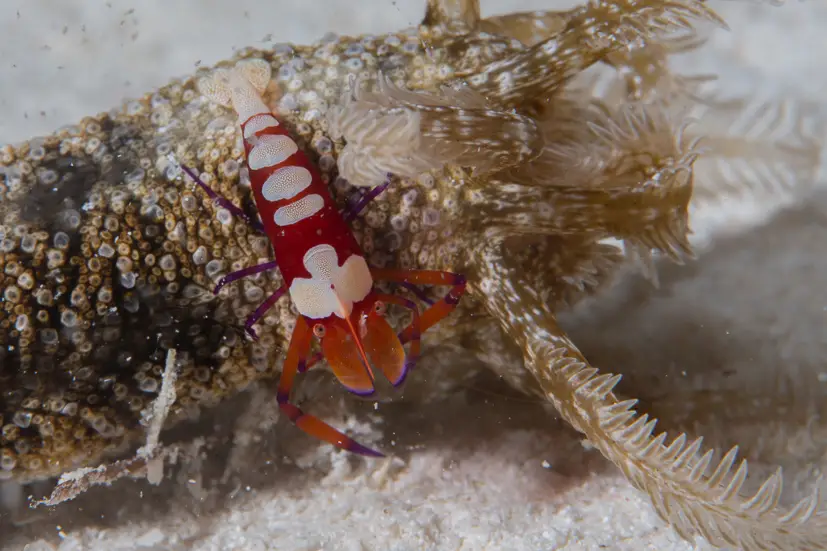
with its striking red and white striped body, resembles a holiday candy cane. The sweet-sounding crustacean has a symbiotic relationship with a goby – they depend on each other for survival. The shrimp helps dig and maintain a burrow, while the goby alerts the nearly-blind shrimp to any nearby dangers. Their bright, festive appearance adds a touch of holiday cheer to the reefs they inhabit.
2.Parasitism: one organism benefits at the expense of the other.
A well-known example of this is the relationship between certain fish and parasitic isopods. The isopod enters the fish’s body through its gills and attaches itself to the fish’s tongue. Over time, the isopod feeds on the fish’s tongue and eventually replaces the fish’s tongue with its own body, essentially becoming the fish’s “new tongue.” The isopod gains nourishment from the fish, but the fish suffers from the loss of its tongue, which impairs its ability to feed properly making this a parasitic interaction.
3. Mutualism: when both organisms in a relationship benefit.
One of the best-known examples of mutualism in the marine world is the partnership between clownfish and sea anemones. The clownfish finds shelter within the stinging tentacles of the anemone, which provides protection from predators. In return, the clownfish cleans the anemone by eating parasites and debris, while its movements help circulate water around the anemone, aiding its respiration. This mutually beneficial relationship helps both species thrive.
4. Competition: when organisms vie for the same resources, such as food, territory, or mates.
In the ocean, many species of fish and invertebrates compete for access to limited food sources. For example, different species of reef fish may compete for the same corals or algae, using aggressive behaviors or territoriality to secure their share. This competition can influence feeding patterns, reproductive success, and the distribution of species across marine ecosystems.
The ocean is a dynamic ecosystem where organisms form symbiotic relationships like commensalism, parasitism, and mutualism, shaping their survival and the marine environment. Competition for resources drives adaptation, creating a complex web of life beneath the waves.
Click here to read the whole Newsletter
Author: Emma Keen
2025 January: Q & A with our Marine Biologist Emma Keen
Why do dolphins swim close to boats?
Dolphins often swim close to boats out of curiosity and playfulness, as they are naturally inquisitive creatures. They may ride the bow waves created by the boat, which allows them to conserve energy while swimming, and their proximity can be a social behavior, as they enjoy interacting with humans.
Will the sharks bite?
Sharks generally do not pose a threat to humans, and bites are relatively rare. Most species of sharks are not aggressive and tend to avoid human interaction; However, they may bite if they feel threatened or if they mistake a person for their natural prey. It’s essential to practice caution in areas where sharks are present, and to avoid disturbing a sharks natural behaviour.
Are stingrays dangerous?
Stingrays can be dangerous if provoked, primarily due to their venomous spines located on their tails, which they use for defense. While they are usually docile and pose little threat to humans, accidental steps on them while wading in shallow waters can lead to painful stings, making it important to be cautious, and try to shuffle your feet if walking in a sandy bottom area if the visibility isn’t great!
What do turtles eat?
Turtles have diverse diets that vary by species; some are herbivores, feeding on seagrasses and algae, sponges and anemones, while others are carnivores, eating crustaceans, and fish. Omnivorous turtles, and most species of turtles as juveniles will eat a mix of both plant and animal matter, depending on their habitat and availability of food sources, until they become more fussy as adults! All species turtles love to eat jellyfish as their favourite snack!
Click here to read the whole Newsletter
Author: Aliona Shavel


